
Digitizing a Career Fair: A Case Study
How TECONOMY Leoben took the step to digital fair management with Konvio.
The Problem: Career Fairs Still Run Like They Did 10 Years Ago
Career fairs are among the most important recruiting events in the DACH region. Every year, thousands of visitors meet hundreds of companies. Whether at universities, in exhibition halls, or at convention centers: for organizers, they are complex to coordinate. For exhibitors, they are one of the most direct paths to new contacts and talent.
The organization behind it all? Mostly still analog.
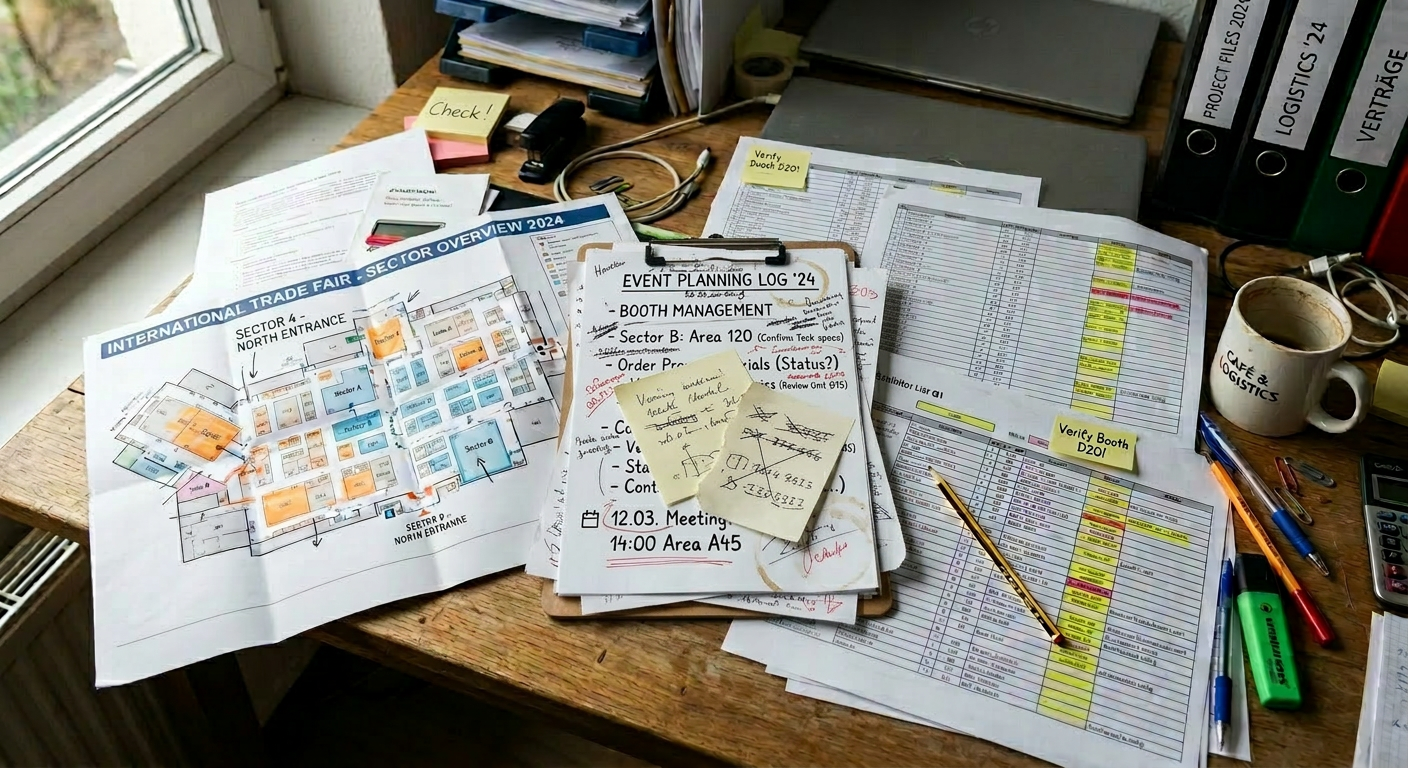
Excel spreadsheets for exhibitor management. Each exhibitor a row, each change a manual update. Who booked which booth, who has paid, who still needs to submit a logo. All in one document, emailed back and forth between three organizers. Version conflicts included.
PDF plans that need to be re-exported after every booth change. An exhibitor has to cancel, a new one moves up, two want to swap booths. Every time: open the file, adjust, export, send. On the day of the fair itself, the printed plan is often outdated before the first visitors arrive.
And the contact between exhibitors and visitors? It happens at the booth, in conversation. But afterwards? No contact details, no structured follow-up channel. Exhibitors hope that interested visitors will reach out after the fair on their own. Many don't. Good conversations fizzle out because there is no simple way to take the contact with you.
And at the end, the question: Was it worth it? How many visitors were at which booth? What target groups were represented? Was the effort justified? No data, no answer. The report to the team or management remains vague: "It was well attended."
This is not an isolated case. Most career fairs in the DACH region operate with exactly this setup. Not because it works, but because "that's how it's always been done." The alternative to organizing fairs with Excel has simply been missing.
Why Existing Tools Often Don't Fit
There is software for fair management. Large platforms, built for international trade shows with thousands of exhibitors and million-dollar budgets.
The problem: these solutions are designed for a different entry point. Long contract terms, months of implementation, pricing models that don't work for a career fair with 50 to 100 exhibitors. Before you even create the first exhibitor profile, weeks of configuration and training are required.
What many organizers need is a fast start. A system that works right away, without a dedicated project team for implementation. Something that runs in days, not months. And that an organizing team without an IT department can operate on their own. More than Excel and PDF, but without the onboarding overhead of an enterprise platform.
The Starting Point: TECONOMY Leoben
TECONOMY Leoben is one of the largest career fairs at an Austrian university. Over 1,000 visitors, more than 70 exhibitors, organized by a volunteer team from IAESTE Leoben at the Montanuniversität.
The challenges are typical for career fairs of this size: coordinating exhibitors, maintaining floor plans, enabling contact exchange, keeping oversight on the day of the fair.
The team wanted to take the next step. Away from Excel and PDF, toward a platform that combines exhibitor management, floor plan, and contact exchange in one place. Without a months-long project, without IT expertise. Ready to go in days.
The Solution: Konvio as a Digital Fair Platform
Konvio was built for exactly this use case: career fairs and trade fairs that need digital infrastructure without months of implementation. Fair management software tailored to the needs of small and mid-sized organizers.
For TECONOMY Leoben, the deployment covered three core areas:
1. Digital Exhibitor Management
Each exhibitor received their own profile in Konvio. Contact details, booth number, logo. Everything in one place, always up to date. Organizers no longer need to send Excel lists via email or manually merge changes. Every update is immediately visible to the entire team.
Exhibitor management becomes routine instead of a bottleneck. Instead of "Who has the current version?" it's: "There is only one version, and it's always current."
2. Interactive Floor Plan
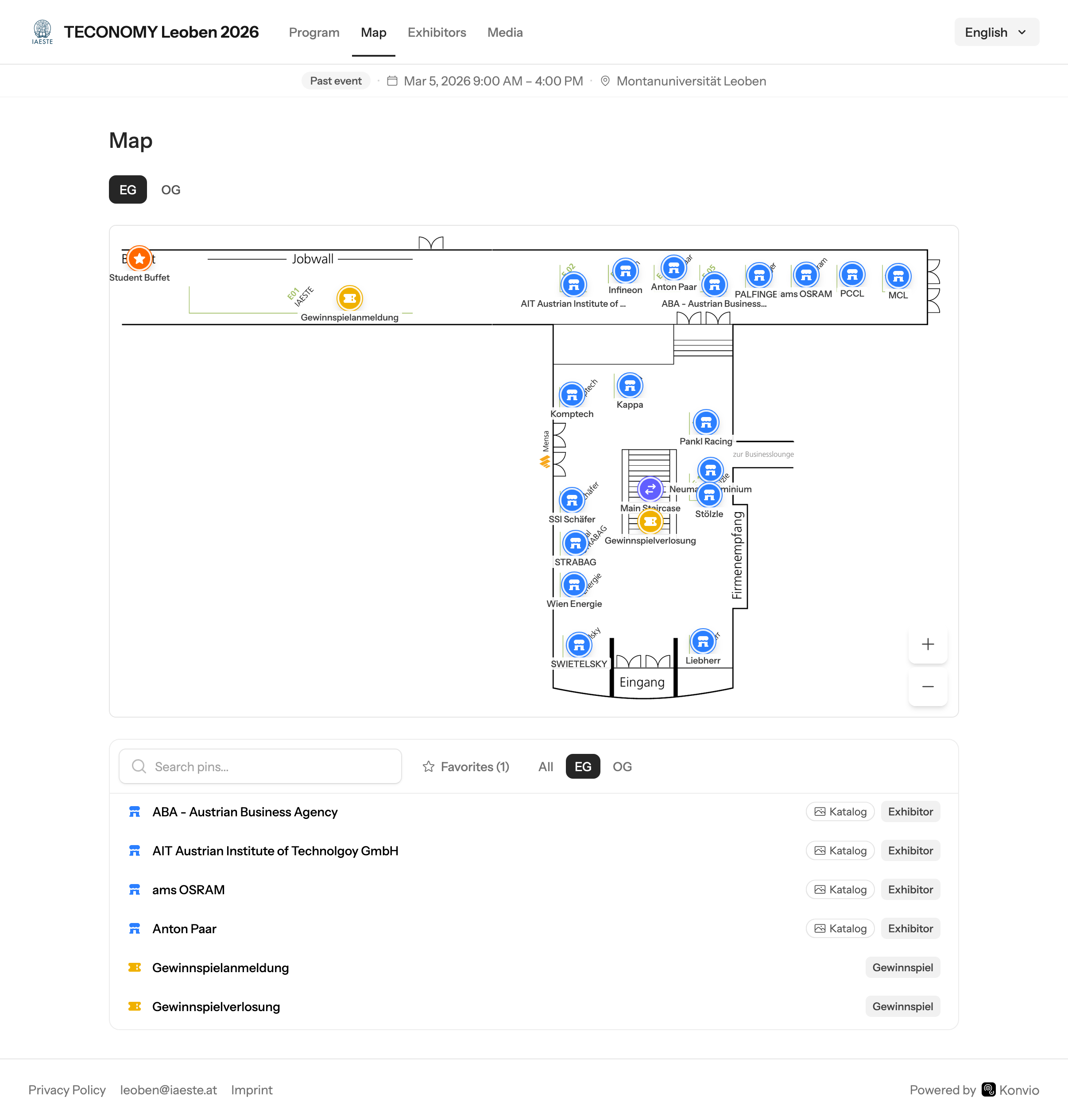
Instead of a static PDF plan, visitors got an interactive digital floor plan. Search for exhibitors, filter by industry, save favorites, navigate directly to the booth. On their smartphone, without an app download.
For organizers, this solves a concrete problem: updating booth changes in real time, without sending out a new PDF. No reprinting posters. No "the plan on the wall is outdated." The floor plan is always current because it's digital.
For visitors, it means: finding the exhibitors that are relevant, efficiently. Not studying the entire plan and hoping to find the right booth. Instead, filter, search, go directly there.
3. Digital Contact Exchange via QR Code
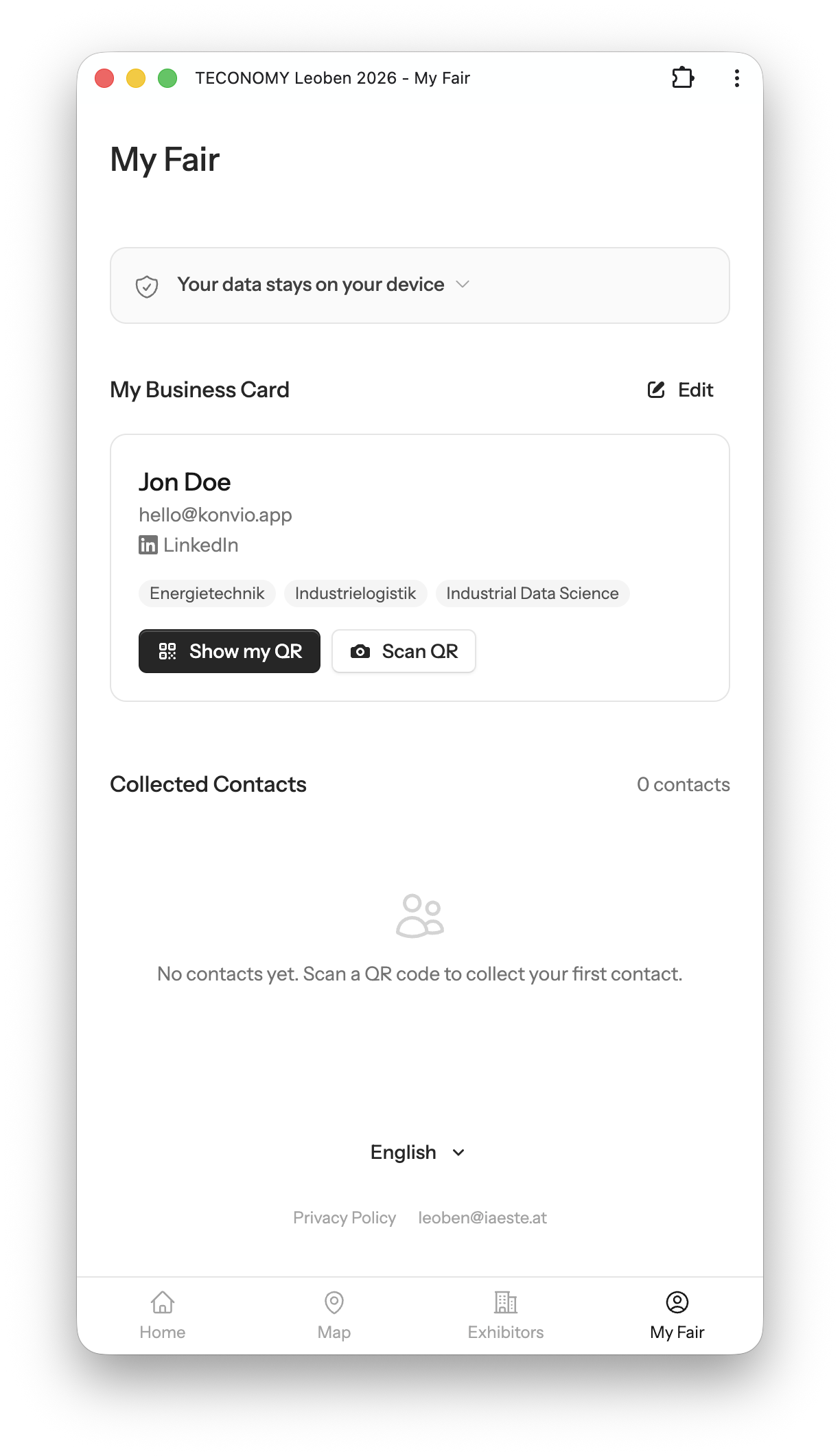 Visitors and exhibitors exchange contact details via QR codes. Scan at the booth, done. Both parties have the contact digitally right away. This solves a problem career fairs have had for years: great conversations at the booth, but no simple way to continue the contact afterwards.
This fundamentally changes post-event follow-up. Until now, the process was: good conversations at the booth, but then what? Wait and see if anyone reaches out. No structured return channel, no contact data, no follow-up. With the digital exchange, both sides have the contact immediately. Exhibitors can proactively follow up after the fair instead of passively hoping; visitors have a direct line to the person they spoke with at the fair, without having to collect physical business cards or search for them online.
Contact data is exchanged using the zero-knowledge principle. The server facilitates the exchange but never sees the content in plain text. Privacy is part of the architecture, not an add-on feature. For fairs in the DACH region, where GDPR compliance is not optional, this is a decisive point.
The Results
1,000+ visitors used the digital platform
70+ exhibitors were represented with dedicated profiles in Konvio
Around 20 digital contacts were captured via the QR code exchange. For a first deployment without promotion, a promising start showing the feature gains traction once users are aware of it.
Setup in days, not months: The entire platform was ready to go within a few days
No app download required: Everything runs in the browser, on any device
Distribution was simple: a QR code on the fair catalogs, a link via email to participants. Done. No installation, no registration barrier.
This is a point many organizers underestimate: the best technology is worthless if visitors don't use it. The lower the barrier to entry, the higher the adoption. A link in the browser is the lowest barrier there is.
The Proof: TECONOMY Linz Confirms the Model
A few weeks after Leoben, the request came from TECONOMY Linz. Short notice, just a few days before the fair. No long lead time, no project plan. The question was: Is this possible?
Konvio was live in no time. No custom development, no workarounds. The same system, a different location. At Johannes Kepler University Linz, with a different team, under time pressure.
This is the decisive point when you want to digitize a career fair: the solution must be repeatable. What works in Leoben must also work in Linz. Without weeks of customization, without specialized knowledge, without an IT department.
For organizers, this means: you don't have to start from scratch. You don't have to evaluate, implement, and train for months. You can digitize the fair and still be live by next Thursday.
What Organizers Can Learn from This
If you want to digitize a career fair, you don't have to change everything at once. It's not about transforming the entire process overnight. It's about starting with the levers that have the biggest impact.
Three areas that make an immediate difference:
First: Centralize exhibitor management. Move away from email and Excel, toward a system where all information is in one place. Manage exhibitors, assign booths, maintain profiles. One system the whole team can see, instead of a file that one person manages.
Second: Make the floor plan digital. Visitors expect to be able to check on their smartphone where an exhibitor is located. They want to filter, search, navigate. A PDF cannot deliver that. An interactive floor plan can.
Third: Digitize the contact exchange. The contact between exhibitor and visitor is the actual value of a fair. But until now, after the conversation at the booth, nothing tangible remains. Exhibitors wait to see if anyone reaches out. Many don't. When the contact is captured digitally, both sides can follow up. And when exhibitors know after the fair who they spoke with, they rebook for the following year. That is the strongest argument for rebooking.
Common Concerns About Digitization
When thinking about digitizing a career fair for the first time, organizers often have similar questions:
"Our team is volunteer-based, we have no IT capacity." That's exactly what Konvio was built for. TECONOMY Leoben is organized by a volunteer team. No IT team, no budget for months-long projects. If it works there, it works with your team too.
"Our exhibitors aren't technically minded." The QR code contact exchange works with any smartphone and any browser. No app download, no registration. One scan, done.
"We don't want to change everything at once." You don't have to. You can start with the digital floor plan and add the contact exchange next year. Or the other way around. The components work individually and together.
Conclusion
TECONOMY Leoben showed that a career fair can be digitized in just a few days. In live operation with over 1,000 visitors and 70+ exhibitors. Organized by a volunteer team, without an IT department and without a months-long project.
TECONOMY Linz confirmed a few weeks later that the model is repeatable. Short notice, at a different location, with a different team.
Konvio was built by a fair organizer who has himself organized over 20 career fairs. The problems Konvio solves are not theoretical scenarios. They are the problems every organizer knows who has ever organized a career fair with Excel, PDF, and paper.
If you want to set up your next career fair digitally, you can take a look at the system with no obligation.